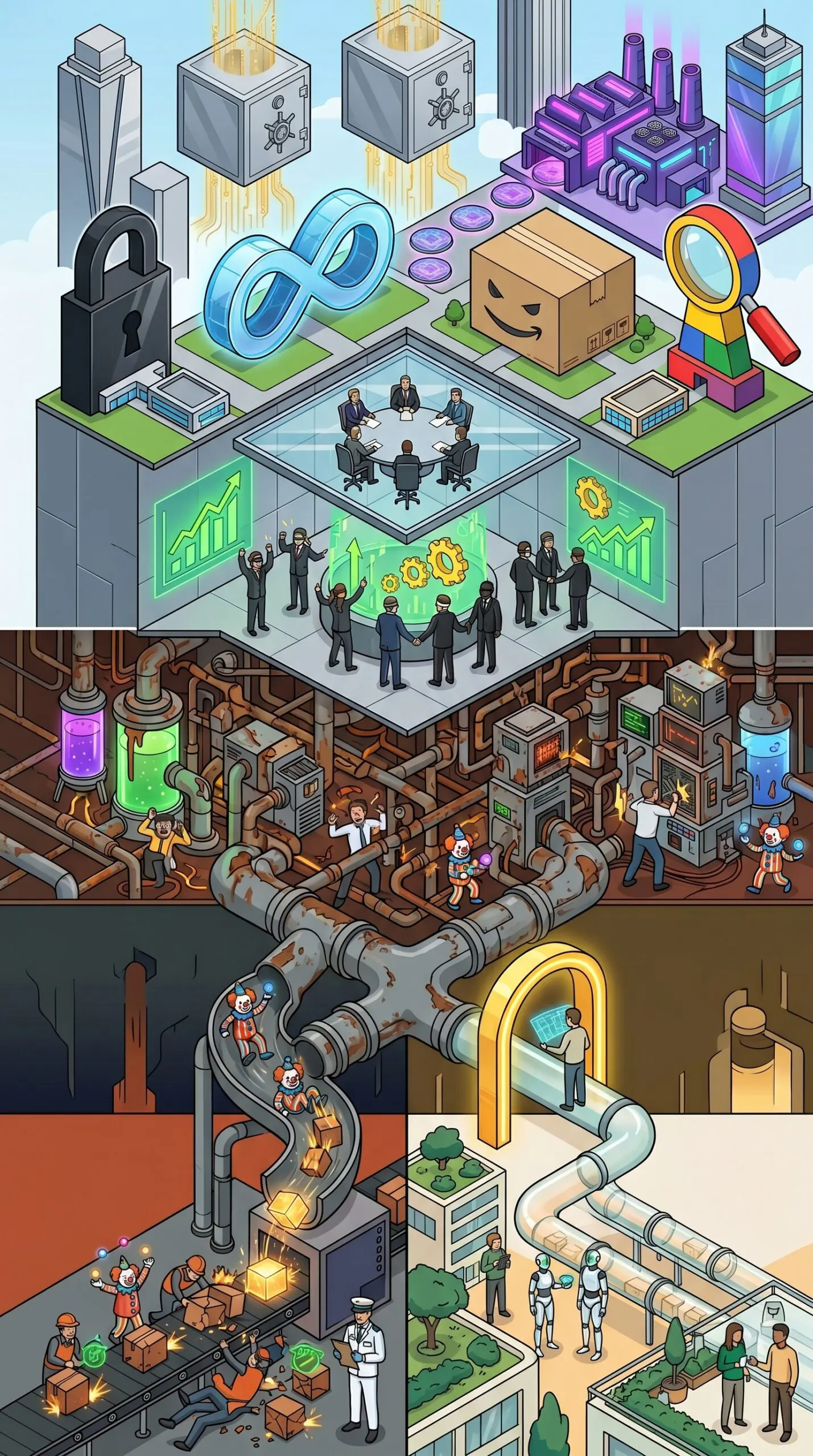
Not ‘what should we do?’ but ‘where exactly are we and what are we standing on?’
NeoHumxn.io is a post-automation operating system, not a brand. It is a small stack of working ideas: a core lens, two world models, and an OS view for deciding what kind of society we are quietly building with AI.
Orientational Intelligence (OI)
Sensemaking for systems: where we are, what is in play, what we are feeding into AI.In reality, teams are deploying into systems they have never fully mapped: with incentives, power flows and human costs no one has named out loud.
Orientational Intelligence is the missing layer underneath that stack: the capacity to locate ourselves inside a live system, see how power, incentives, and bodies actually move, and understand which direction we are drifting before we start optimising.
What OI actually does- Establishes position. It answers where am I in this situation? What has happened, what keeps recurring, what changed since last time, what stalled.
- Reveals structure. It maps actors, power, rules and pathways: who is involved, who decides, which processes and jurisdictions this case actually sits inside.
- Surfaces constraints. It makes time limits, dependencies, evidence thresholds and cultural expectations explicit instead of leaving them in your head as background anxiety.
- Preserves ambiguity. It keeps track of what is contested, unknown or unproven, including who dismissed what, instead of pretending the uncertainty is not there.
- As the lens behind every AI shipment: which operating model does this choice quietly feed?
- As the design rule for any future tools, diagrams, or case views here: no execution without an orientation of the current context first.
- As a quiet, recurring question under every article and artefact: where are we in this system, what is the shape of this situation, and what do we still not know yet?
- AI roadmap meetings become conversations about world-building, not just features and deadlines.
- Trade-offs and harms have to show up in the spec, not hide behind that is just how the industry works.
- Leaders can say, in plain language: right now, this programme is building Automation-First here. If we want Rehumanized instead, these are the incentives, roles and metrics we have to change.
/artefacts/orientational-intelligence
Two World-Models: Automation-First vs Re-Humanised World
Same technology. Different operating specs.Automation-First Operating Model
Devil World · The default when incentives stay the sameAutomation-First World is not a movie villain. It is the default operating model you get when AI is deployed under today’s incentives: automate to cut cost, not to reduce harm.
- Efficiency over dignity; metrics over meaning.
- Humans as the admin layer between capital and machines.
- Surveillance packaged as productivity tooling.
- Care and manual work outsourced, under-paid, or ignored.
/artefacts/automation-first-operating-model (coming soon).
Re-Humanised World Operating Model
Saint World · A different direction, not a perfect utopiaRe-Humanised World is the counter-model: a target operating model for a rehumanised, post-automation society. Not perfection, just a different spec for what we let AI amplify and what we protect as human work.
- AI used to free capacity for care, craft, repair and learning.
- Embodied and relational work treated as infrastructure, not cost.
- Governance decides what must stay human-touch by design.
- Shorter formal work weeks; stronger local responsibility and guilds.
/artefacts/rehumanised-world-operating-model (coming soon).
The NeoHumxn OS
Society as a stack you can actually re-wire.Beneath Orientational Intelligence and the world models sits the NeoHumxn OS: a way of looking at society as a stack instead of a fog of complex systems. Six layers. Each one producing the next.
-
L1Central Authority Governments, corporations, tech platforms. Who holds formal power and writes the story on top? Backdoor Influence · Narrative ControlFormal Power
-
L2Shadow Layers Elite finance, data brokers, lobbying. Money and influence that never make it onto official charts. Invisible Pressure · Cultural ProgrammingHidden Power
-
L3Interface Layer Media, religion, education, influencers. What the system wants you to believe. Policy & Role DistributionNarrative
-
L4Federated Structures Bureaucracy, ministries, VPs, local councils. Translating policy into work orders that hit real people. Execution & EnforcementExecution
-
L5Distributed Workforce From coders to care workers. Where orders hit bodies, time and nervous systems. White-collar and blue-collar both. Service & SurveillanceLabor
-
L6The Human Being The kind of person this stack keeps producing: numb, compliant consumer, or sovereign, alive being. The OS decides which. You can decide to rewire it.The Point
Inside the OS: Neo-Manualism
For decades, real work has meant screens: code, emails, decks, financial instruments. Manual, embodied and care work was pushed to the margins, underpaid, feminised, or outsourced, even though it keeps bodies, homes and ecosystems alive.
In a post-AI world, that hierarchy collapses. If machines can chew through endless symbolic work, the scarce, precious things become the ones only bodies can do: tending, repairing, cooking, holding, growing, healing.
- Manual and care labour becomes central infrastructure, not invisible background.
- Digital knowledge work is treated as one layer in the stack, not the pinnacle of human achievement.
- Value is measured in repair, regeneration and relation, not just in throughput and quarterly charts.
/artefacts/neo-manualism and /artefacts/neohumxn-operating-system (coming soon).