The Framework

Operating System Overview

Not ‘what should we do?’ but ‘where exactly are we and what are we standing on?’

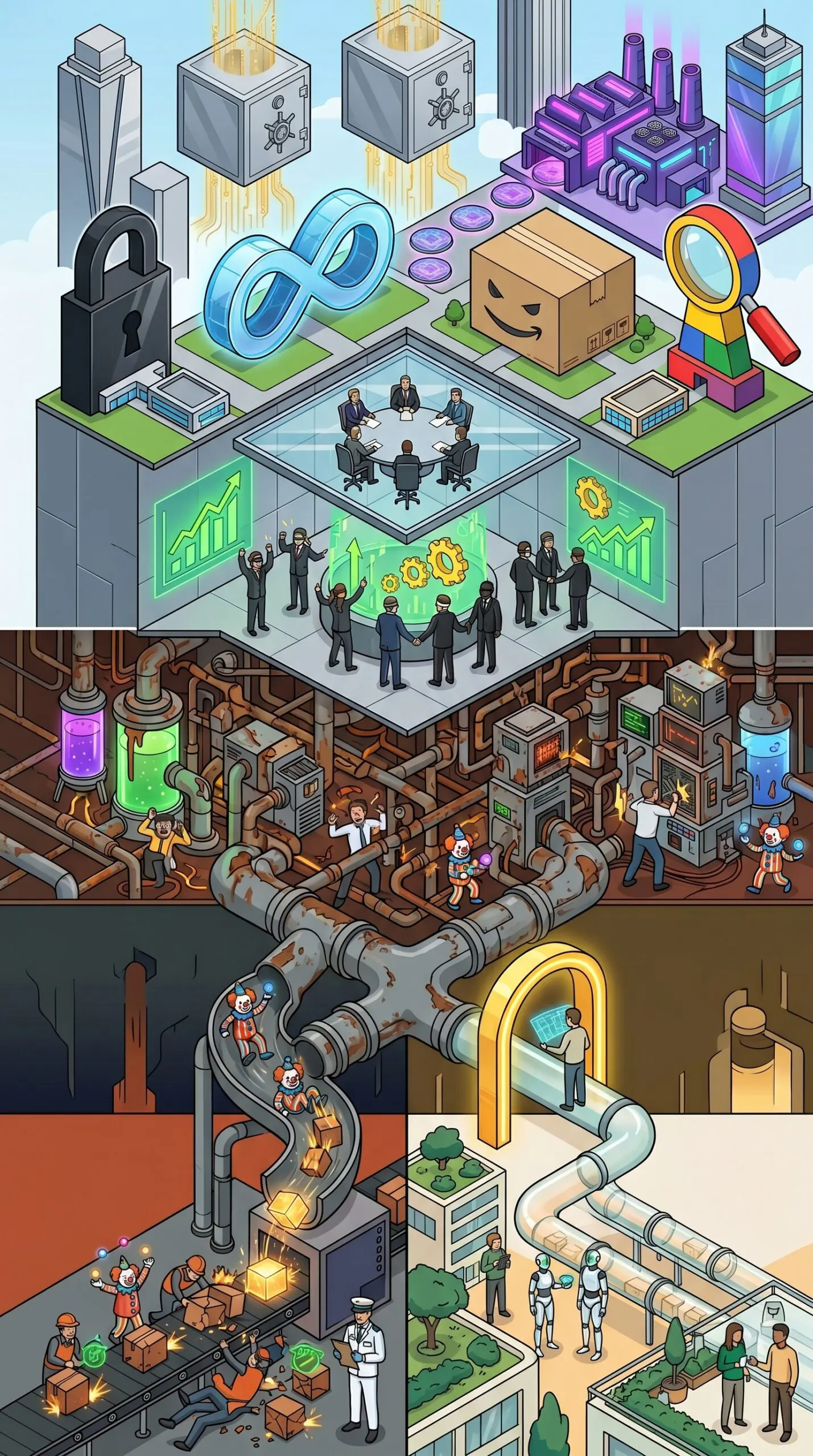
NeoHumxn.io is a post-automation operating system, not a brand. It is a small stack of working ideas: a core lens, two world models, and an OS view for deciding what kind of society we are quietly building with AI.


Orientational Intelligence (OI)

Sensemaking for systems: where we are, what is in play, what we are feeding into AI.
Orientational — Where am I? Diagnostic — What’s wrong? Descriptive — What happened? Predictive — What next? Prescriptive — What to do?
Most AI work starts in the same place: What can we automate? How much can we optimise? How fast can we ship the agent? Those are execution questions. They assume the context is already fine.

In reality, teams are deploying into systems they have never fully mapped: with incentives, power flows and human costs no one has named out loud.

Orientational Intelligence is the missing layer underneath that stack: the capacity to locate ourselves inside a live system, see how power, incentives, and bodies actually move, and understand which direction we are drifting before we start optimising.

What OI actually does
  • Establishes position. It answers where am I in this situation? What has happened, what keeps recurring, what changed since last time, what stalled.
  • Reveals structure. It maps actors, power, rules and pathways: who is involved, who decides, which processes and jurisdictions this case actually sits inside.
  • Surfaces constraints. It makes time limits, dependencies, evidence thresholds and cultural expectations explicit instead of leaving them in your head as background anxiety.
  • Preserves ambiguity. It keeps track of what is contested, unknown or unproven, including who dismissed what, instead of pretending the uncertainty is not there.
How OI shows up on NeoHumxn.io
  • As the lens behind every AI shipment: which operating model does this choice quietly feed?
  • As the design rule for any future tools, diagrams, or case views here: no execution without an orientation of the current context first.
  • As a quiet, recurring question under every article and artefact: where are we in this system, what is the shape of this situation, and what do we still not know yet?
How OI changes decisions
  • AI roadmap meetings become conversations about world-building, not just features and deadlines.
  • Trade-offs and harms have to show up in the spec, not hide behind that is just how the industry works.
  • Leaders can say, in plain language: right now, this programme is building Automation-First here. If we want Rehumanized instead, these are the incentives, roles and metrics we have to change.

Two World-Models: Automation-First vs Re-Humanised World

Same technology. Different operating specs.

Automation-First Operating Model

Devil World · The default when incentives stay the same

Automation-First World is not a movie villain. It is the default operating model you get when AI is deployed under today’s incentives: automate to cut cost, not to reduce harm.

  • Efficiency over dignity; metrics over meaning.
  • Humans as the admin layer between capital and machines.
  • Surveillance packaged as productivity tooling.
  • Care and manual work outsourced, under-paid, or ignored.
Naming Automation-First is about making the current system visible, diagrammable, and therefore rejectable.
Model: /artefacts/automation-first-operating-model (coming soon).

Re-Humanised World Operating Model

Saint World · A different direction, not a perfect utopia

Re-Humanised World is the counter-model: a target operating model for a rehumanised, post-automation society. Not perfection, just a different spec for what we let AI amplify and what we protect as human work.

  • AI used to free capacity for care, craft, repair and learning.
  • Embodied and relational work treated as infrastructure, not cost.
  • Governance decides what must stay human-touch by design.
  • Shorter formal work weeks; stronger local responsibility and guilds.
Without an explicit Re-Humanised World, Automation-First World hardens by inertia. This is the alternate operating spec.
Model: /artefacts/rehumanised-world-operating-model (coming soon).

The NeoHumxn OS

Society as a stack you can actually re-wire.

Beneath Orientational Intelligence and the world models sits the NeoHumxn OS: a way of looking at society as a stack instead of a fog of complex systems. Six layers. Each one producing the next.

  • L1
    Central Authority Governments, corporations, tech platforms. Who holds formal power and writes the story on top? Backdoor Influence · Narrative Control
    Formal Power
  • L2
    Shadow Layers Elite finance, data brokers, lobbying. Money and influence that never make it onto official charts. Invisible Pressure · Cultural Programming
    Hidden Power
  • L3
    Interface Layer Media, religion, education, influencers. What the system wants you to believe. Policy & Role Distribution
    Narrative
  • L4
    Federated Structures Bureaucracy, ministries, VPs, local councils. Translating policy into work orders that hit real people. Execution & Enforcement
    Execution
  • L5
    Distributed Workforce From coders to care workers. Where orders hit bodies, time and nervous systems. White-collar and blue-collar both. Service & Surveillance
    Labor
  • L6
    The Human Being The kind of person this stack keeps producing: numb, compliant consumer, or sovereign, alive being. The OS decides which. You can decide to rewire it.
    The Point

Inside the OS: Neo-Manualism

For decades, real work has meant screens: code, emails, decks, financial instruments. Manual, embodied and care work was pushed to the margins, underpaid, feminised, or outsourced, even though it keeps bodies, homes and ecosystems alive.

In a post-AI world, that hierarchy collapses. If machines can chew through endless symbolic work, the scarce, precious things become the ones only bodies can do: tending, repairing, cooking, holding, growing, healing.

  • Manual and care labour becomes central infrastructure, not invisible background.
  • Digital knowledge work is treated as one layer in the stack, not the pinnacle of human achievement.
  • Value is measured in repair, regeneration and relation, not just in throughput and quarterly charts.
Within the NeoHumxn OS, Neo-Manualism is how we re-anchor the operating system around hands, bodies and local skills, so the future we automate toward still has room for fully alive humans.
Concepts: /artefacts/neo-manualism and /artefacts/neohumxn-operating-system (coming soon).